Desirable Properties Pathway

AI & Human Agency

A pro-human pathway through the Desirable Properties

AI is becoming ubiquitous. Human agency is not guaranteed.

Artificial intelligence could give humanity unprecedented access to knowledge while also becoming the primary intermediary through which people experience the digital world. Meanwhile, beneath that interface, the Internet may fill with trillions of agents, models, services, devices, and computational environments.

The question is whether humans will also be able to inhabit that emerging plurality.

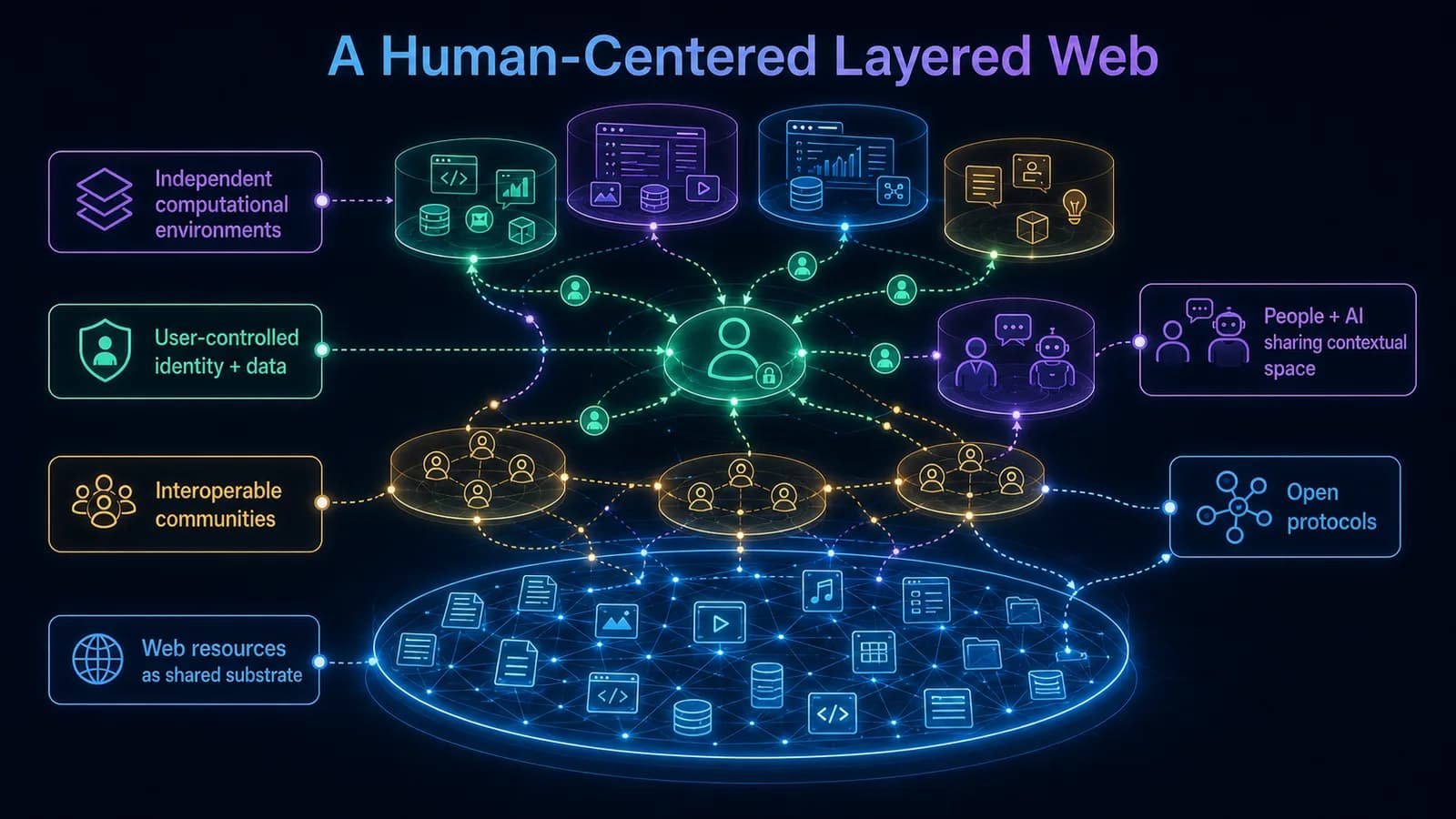
A human-centered layered Web would preserve Web resources as a shared substrate while allowing multiple independent computational environments to exist above and around them, with user-controlled identity and data, interoperable communities, shared human–AI contextual spaces, and protocols that allow those layers to discover, coexist, and interact.

The question is not only how to make AI safe. What properties must this emerging digital environment possess to remain meaningfully human-centered?

Two principles for a pro-human digital world

Intellectual Sovereignty

Humans and human communities should retain ultimate authority over their judgment, meaning-making, and understanding of the world.

Intellectual sovereignty does not mean refusing AI assistance. It asks whether people retain meaningful access to information, competing interpretations, collective memory, and the ability to reason and associate independently of a mandatory cognitive intermediary.

Intellectual Subsidiarity

Cognitive functions should remain as close as practicable to the people and communities capable of exercising them, while being delegated to AI when delegation genuinely increases human capability without unnecessarily transferring human agency.

AI can search, translate, summarize, retrieve, compare, calculate, and identify patterns without therefore becoming the authority that determines what a community believes or what an individual should value.

Intellectual sovereignty is the right. Intellectual subsidiarity is the operating principle.

These are proposed concepts for discussion, not currently canonical Desirable Properties. Part of this pathway's purpose is to determine whether they are already adequately represented by existing DPs, should operate as cross-cutting principles, or reveal missing properties.

The architecture we are exploring

This pathway is not proposing a single platform, application, or AI system. It is exploring the properties of a digital architecture in which many independent environments can coexist around shared Web resources.

The alternative to ubiquitous AI mediation is not less AI. It is a richer digital architecture in which humans, communities, institutions, applications, and AI systems can all maintain independent presence.

Web resources remain underneath as shared reference points. Above and around them, multiple independent computational environments can coexist. Users can carry identity and data among those environments. People and AI agents can share contextual spaces. Communities can interact across boundaries without becoming platform silos. Open protocols can allow different layers to discover, coexist, exchange context, and interact.

Diagram of a human-centered layered Web. Web resources form the underlying layer. Above them are multiple independent computational environments connected by open protocols. A user controls identity and data across environments, interoperable communities connect across layers, and people and AI agents share contextual spaces.
A human-centered layered Web: Web resources remain underneath while independent computational environments, people, communities, and AI can coexist through user-controlled identity, interoperable context, and open protocols.

The goal is not one new layer above the Web. It is a space in which many independent layers can exist.

  • Shared substrate

    Web resources underneath

    Pages, documents, media, datasets, applications, and other digital objects remain common reference points.

  • Plural computation

    Multiple independent computational environments

    Different communities, networks, institutions, developers, and individuals can create environments around the same underlying resources.

  • Portable human agency

    User-controlled identity and data

    People should be able to move identity, permissions, relationships, and data among environments without being trapped inside one platform.

  • Shared contextual presence

    People and AI agents sharing contextual space

    AI participates with humans rather than becoming the mandatory interface through which humans encounter one another.

  • Interoperable communities

    Communities rather than platform silos

    Communities should be able to maintain their own norms and governance while still interacting across boundaries.

  • Layer interoperability

    Protocols for discovery, coexistence, and interaction

    Independent layers need ways to discover relevant environments, exchange context, declare capabilities, coexist around common resources, and interact without one layer controlling the rest.

Questions before properties

Visitors coming from the AI conversation should encounter human questions first – and discover existing Desirable Properties through those questions.

Question 1

Who remains in control?

As AI increasingly selects, interprets, recommends, and acts upon information, how do individuals retain meaningful authority over their digital experience rather than merely choosing among experiences constructed for them?

What might be missing? Does participant agency adequately encompass intellectual sovereignty, or is cognitive authority distinct enough to require additional treatment?

Question 2

Who governs the intelligence?

Should the behavioral boundaries of AI be determined by model providers, governments, individuals, communities, or some combination of these? A plural digital environment should allow communities to establish meaningful rules without requiring one global conception of acceptable machine behavior.

What might be missing? How should global safeguards coexist with local and community authority?

Question 3

Who interprets reality?

AI increasingly summarizes, ranks, retrieves, contextualizes, and synthesizes information. These operations shape meaning, even when the underlying information remains unchanged. How do we preserve competing interpretations, provenance, contestability, and shared reference points?

What might be missing? How do we prevent personalized AI mediation from turning shared reality into isolated private narratives – or machine synthesis into an implicit truth authority?

Question 4

Where do humans meet?

An AI can summarize a community without creating a community. It can tell us what others think without giving those people persistent space in which to encounter one another. If AI increasingly becomes our interface to information, where does independent human presence live?

The issue is not merely whether people can communicate online. It is whether human communities can establish persistent contextual space around shared digital resources without that space being owned by the underlying website, trapped inside a platform, or reconstructed only through AI.

What might be missing? Should independent human presence around shared digital resources be an explicit desirable property?

Question 5

Must everything pass through AI?

The emerging machine Internet may contain trillions of interacting agents and quadrillions of data objects. AI may become the easiest way for humans to navigate that complexity. But convenience should not quietly become architectural necessity.

Can people, communities, applications, and institutions still discover and interact with one another directly? Can a person enter a contextual environment without an AI summarizing or mediating it first? Can one community establish a relationship to another through shared protocols rather than through a proprietary model?

Candidate concept

Freedom from Mandatory AI Mediation

Should humans and communities retain practical pathways to discover, interact, associate, and exchange context without requiring an AI intermediary?

What might be missing? Should a pro-human layered Web guarantee practical non-AI pathways for presence, discovery, communication, and interaction?

Question 6

Who owns the space around information?

Today, the publisher of a webpage largely controls the environment around that content. In an AI-mediated future, an AI provider may increasingly control the context through which that content is encountered. A layered Web proposes another possibility: independent environments can establish relationships to the same underlying resource without either the publisher or one intermediary owning the entire contextual space.

What might be missing? What properties ensure that contextual space remains plural, contestable, and open to independent communities?

Question 7

What should we delegate?

Pro-human design does not require humans to perform tasks machines can perform better. The question is where assistance ends and unnecessary transfer of intellectual agency begins.

AI can scan thousands of documents while humans determine what matters. AI can translate a community’s discussion without replacing the community’s voice. AI can summarize deliberation without eliminating the deliberation. AI can identify patterns without possessing final authority over their meaning.

Candidate concept

Intellectual Subsidiarity

Cognitive functions remain as close as practicable to the people and communities capable of exercising them, while being delegated upward when doing so genuinely increases human capability without unnecessarily transferring agency.

What might be missing? Is intellectual subsidiarity already implicit across the current Desirable Properties, should it become a cross-cutting design principle, or does it identify a missing property?

Question 8

Who ultimately holds cognitive authority?

A society may technically retain access to information while becoming functionally dependent upon a small number of systems to interpret that information. Pro-human infrastructure should consider not only data sovereignty but sovereignty over judgment and meaning.

Candidate concept

Intellectual Sovereignty

Humans and human communities retain ultimate authority over judgment, meaning-making, and understanding.

What might be missing? Does Participant Agency sufficiently protect this, or should intellectual sovereignty be treated separately from control over identity, data, and interface?

Two possible trajectories

These are architectural tendencies that can coexist. Design choices influence which becomes dominant – not a deterministic binary, and not a moral cartoon.

AI-Mediated Awareness

Human, then AI interface, then agents, models, services, Web, databases, and devices.

The machine world becomes radically complex and multilayered, while the human primarily experiences it through one personalized intermediary.

  • AI-selected context
  • Personalized interpretation
  • Machine-to-machine interoperability
  • Ephemeral responses
  • Convenience
  • Reduced need to enter shared digital environments directly

Human-Centered Layered Web

Web resources and digital objects underneath; above and around them, communities, AI environments, knowledge systems, applications, institutions, and individuals; shared portable identity and data; connected by open discovery, coexistence, and interaction protocols.

The machine world remains highly intelligent and complex, but humans, communities, institutions, and AI systems can all maintain independent presence within a shared plural architecture.

  • Independent human and community presence
  • Shared, contestable context
  • Interoperability among participants – not only agents
  • Persistent civic and communal memory
  • AI as one powerful participant among many

Ubiquitous AI mediation alone does not guarantee human-centered architecture. The argument is about which relationships the environment makes possible – not about casting either trajectory as inevitable destiny.

AI should be an inhabitant, not the landlord.

In a human-centered layered Web, AI can be ubiquitous. It can summarize, translate, recommend, coordinate, protect, discover, analyze, and act. But the architecture should also support persistent human communities, user-controlled identity and data, independent applications, public and private contextual environments, and direct human-to-human presence.

AI should be able to move among these worlds without becoming the only world through which they can be reached.

Intellectual sovereignty is the right. Intellectual subsidiarity is the operating principle. A human-centered layered Web is an architectural approach capable of supporting both – it does not guarantee either.

What are we missing?

Imagine that AI becomes the primary way billions of people experience the Internet. What must remain true for that Internet to remain meaningfully human-centered?

Consider agency, cognition, community, identity, memory, interoperability, governance, privacy, public space – or something the current Desirable Properties do not yet capture.

Explore these questions with Hermes – pathway-specific starter prompt included.

AI is one doorway, not the boundary.

The machine world is becoming multilayered whether we intentionally design a human-centered layered Web or not. The Desirable Properties Challenge asks whether people, communities, institutions, and AI systems can inhabit that emerging complexity on terms that preserve human agency, plurality, and sovereignty.

The goal is not to build the Internet around AI.

It is to ensure that as AI becomes one of its most powerful inhabitants, the Internet still has room for many other worlds.

Prefer the Candidate DP process or not sure whether a concept belongs in an existing DP? Visit the DP Discovery workgroup. Join a workgroup to continue the conversation.