
Perspective
A Fork in the Web
Will AI Mediate Reality – or Help Us Build a Human-Centered Internet?
Intellectual sovereignty, intellectual subsidiarity, and why a pro-human future requires more than safe AI.
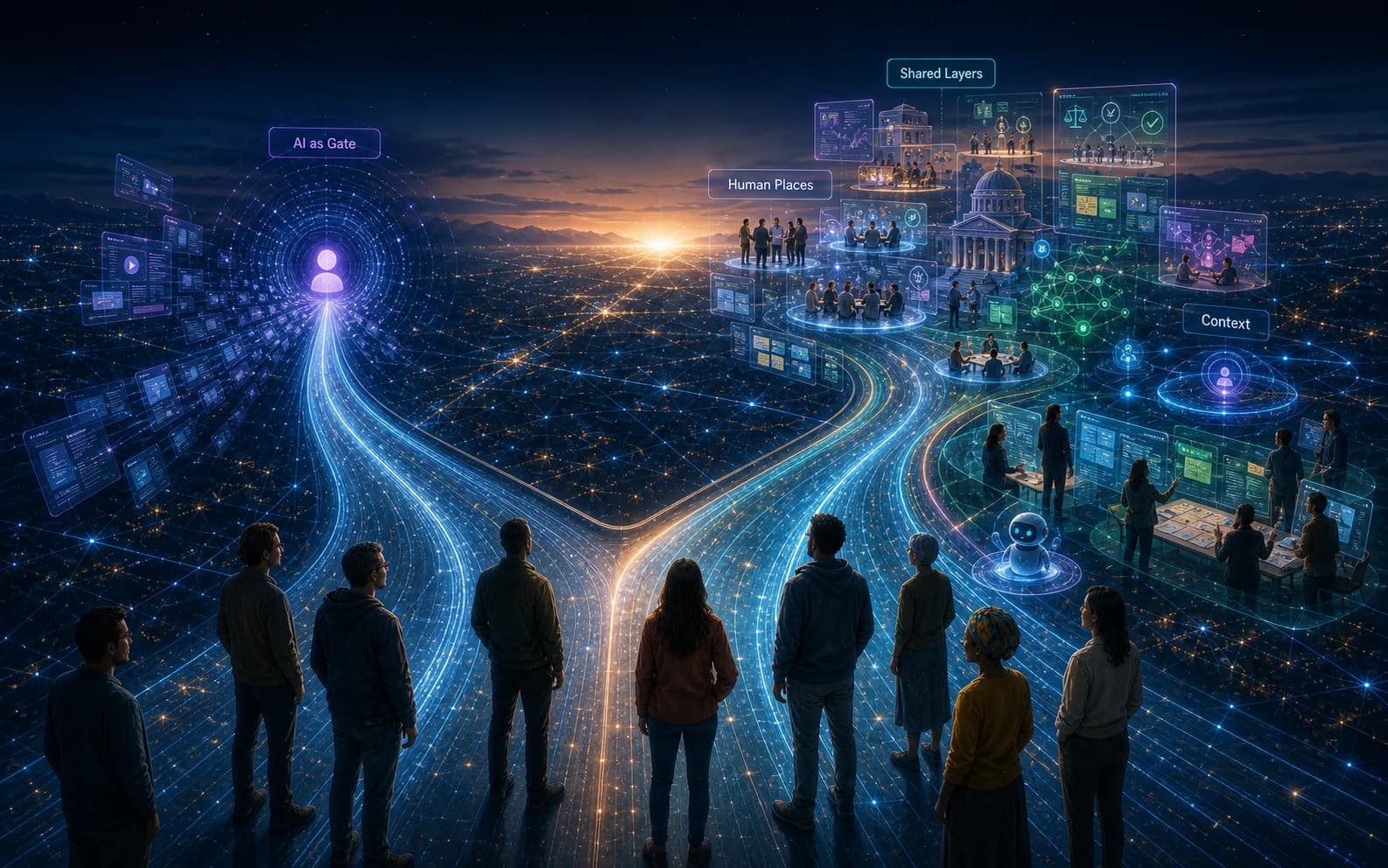
Humanity is pouring extraordinary resources into making intelligence ubiquitous.
Global corporate investment in AI more than doubled in 2025. Private investment increased 127.5 percent, generative AI investment grew by more than 200 percent, and nearly half of all private AI funding went to generative AI. (hai.stanford.edu)
Talent is moving toward AI. Capital is moving toward AI. Political attention is moving toward AI. Product roadmaps are moving toward AI. Entire companies are reinventing themselves around AI.
We should pay attention not only to what this investment creates, but to what it causes us not to build.
The Pro-Human AI Declaration begins with a fork in the road: one path toward replacing human beings and concentrating power, another in which AI remains under human control and strengthens human dignity, liberty, community and self-government. (humanstatement.org)
There is another fork nested inside that one.
It concerns not simply what AI will do to us, but what kind of digital world we will inhabit when AI is everywhere.
One path leads toward what might be called AI-mediated awareness: artificial intelligence increasingly becomes the interface between human beings and the digital world.
The other leads toward a human-centered, multi-layered Internet: a digital environment in which people, communities, institutions and artificial intelligences can coexist in persistent spaces not controlled by any single website, platform or AI intermediary.
These futures are not mutually exclusive. But neither does the first naturally lead to the second. In fact, AI could make the second much less likely.
We could succeed spectacularly at creating ubiquitous intelligence and still fail to create a genuinely human-centered digital civilization.
That possibility deserves far more attention than it is receiving.
The Internet Where We Stop Going to the Internet
Imagine an ordinary day ten years from now. You rarely visit websites because there is increasingly little reason to do so directly. Instead, you ask:
What happened in Congress today?
Find the best treatment options for this condition.
Compare these products.
Tell me what this organization believes.
What are people saying about this research?
Book the trip.
Respond to the important messages.
Find someone who can fix the roof.
Negotiate the price.
Buy it.
The cadence here is not accidental. This is what the AI-mediated Internet promises to feel like: less navigation, less searching, less friction and, eventually, perhaps less direct contact with the underlying Web at all.
Your AI moves through the digital world on your behalf. It searches websites, interrogates databases, watches media, calls software tools, negotiates with other agents, consults your personal history, understands your preferences and constructs the result. Increasingly, the Web may become something machines experience for us.
This is already becoming technically plausible. The Model Context Protocol is creating standardized ways for AI applications to connect with external tools, data and workflows. Agent-to-agent protocols are being developed so that systems created by different organizations can communicate and collaborate. These are valuable developments, and they could make digital systems dramatically more capable.
Yet consider the architecture they may ultimately produce. Beneath the surface could be trillions of AI agents and other computational actors, moving among quadrillions of data objects distributed across specialized models, APIs, websites, databases, blockchains, corporate systems, sensors, personal devices, and digital environments. Computationally, the Internet could become more densely populated, dynamic, and multilayered than anything humanity has ever constructed.
From the human perspective, however, all of that complexity might collapse into something radically simpler:
You → AI → Everything Else.
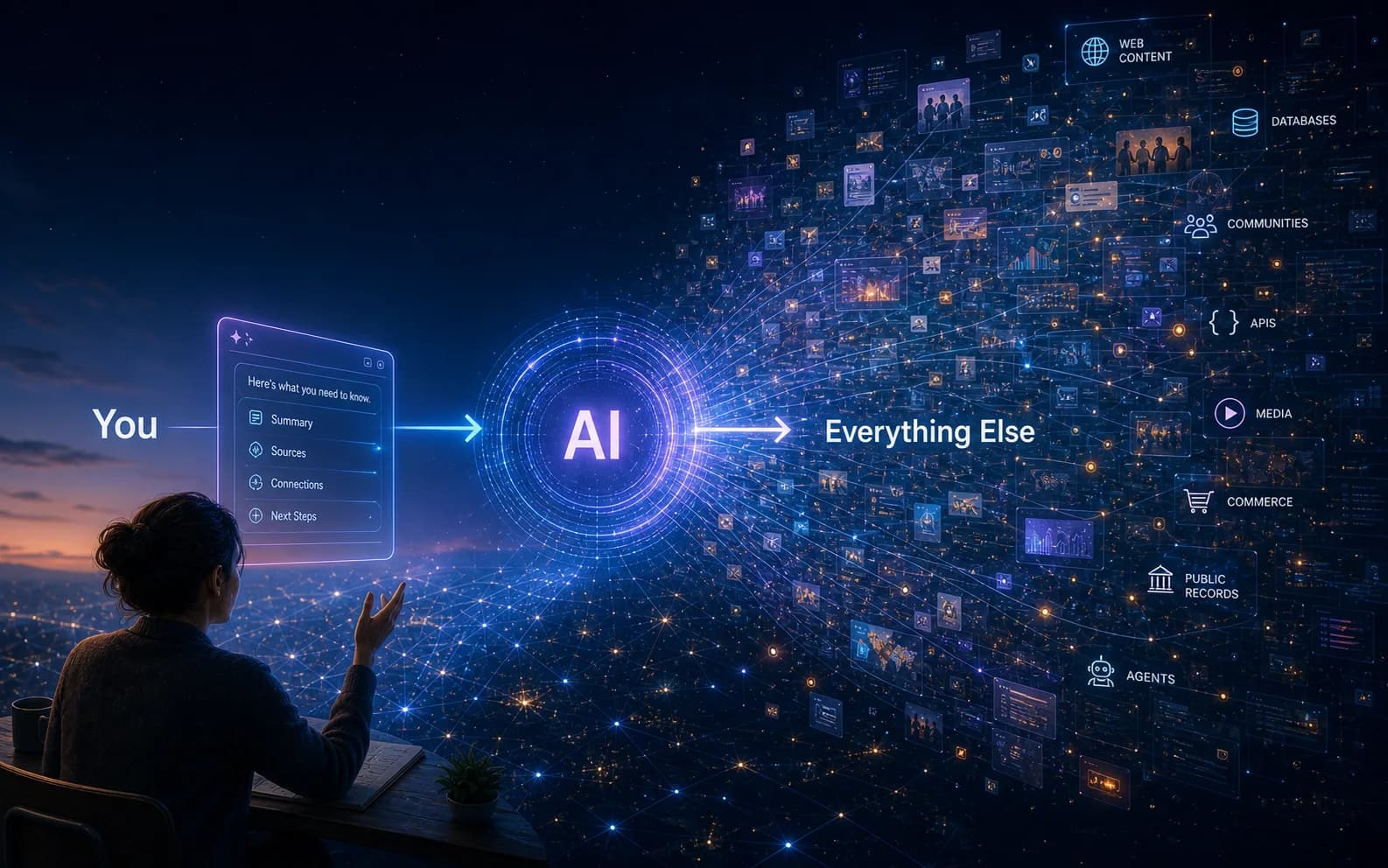
One interface. One conversational relationship. One personalized aperture onto civilization.
We could build the most complex and populous computational environment in history while giving human beings an increasingly single-layered experience of it.
Intelligence Is Not a Place
Part of the confusion comes from describing AI as another “layer” of the Internet. Computationally, that description makes sense. Socially, it may be dangerously incomplete because intelligence and place are different things.
A webpage has persistence. It exists when nobody is looking at it, other people can encounter roughly the same resource, and activity can accumulate around it. A forum develops conversations. A Wikipedia article acquires history. A community develops norms. A library preserves memory. A URL establishes a common address around which human activity can organize.
AI-mediated experiences can work very differently. An answer may be generated specifically for me, reflecting my history, preferences, previous conversations and private context. Your answer may be generated by another system with another context and another conception of what matters. Five minutes later, either of us might receive a different answer again.
There are tremendous advantages to that fluidity and personalization. But we should understand the architectural exchange being made. Ubiquitous intelligence does not necessarily create ubiquitous shared space. It may instead create billions of extremely capable, highly personalized tunnels through the world's information.
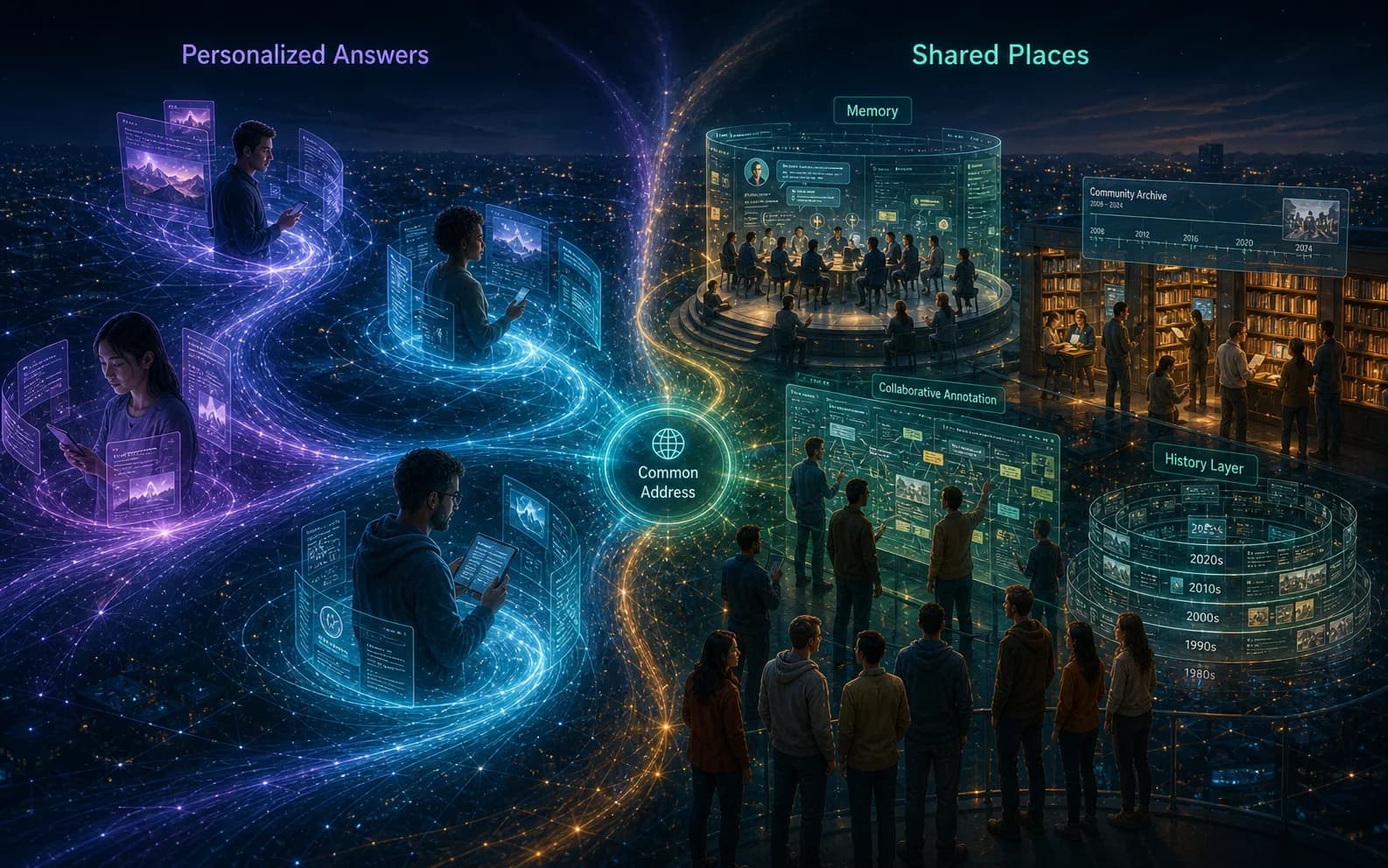
We could know more while encountering one another less. We could gain unprecedented access to knowledge while losing some of the environments in which human beings collectively make sense of knowledge.
That matters because civilization is not simply the accumulation of correct answers. Civilization happens through people remembering, arguing, interpreting, teaching, creating, organizing and deciding together. An intelligence can assist all of those activities without being a substitute for the places in which they happen.
The Privatization of Context
The first generation of Internet centralization concerned infrastructure and distribution. Platforms increasingly determined what people could publish, who could reach an audience and what information appeared in front of them.
AI introduces the possibility of a more intimate form of centralization: the privatization of context.
An AI does not merely retrieve information. It can determine which information appears relevant, summarize a controversy, select background facts, identify criticism, decide which voices appear authoritative, remember what the user previously believed and adjust its explanation accordingly. As AI systems become more agentic, they can increasingly act upon the interpretation they have constructed.
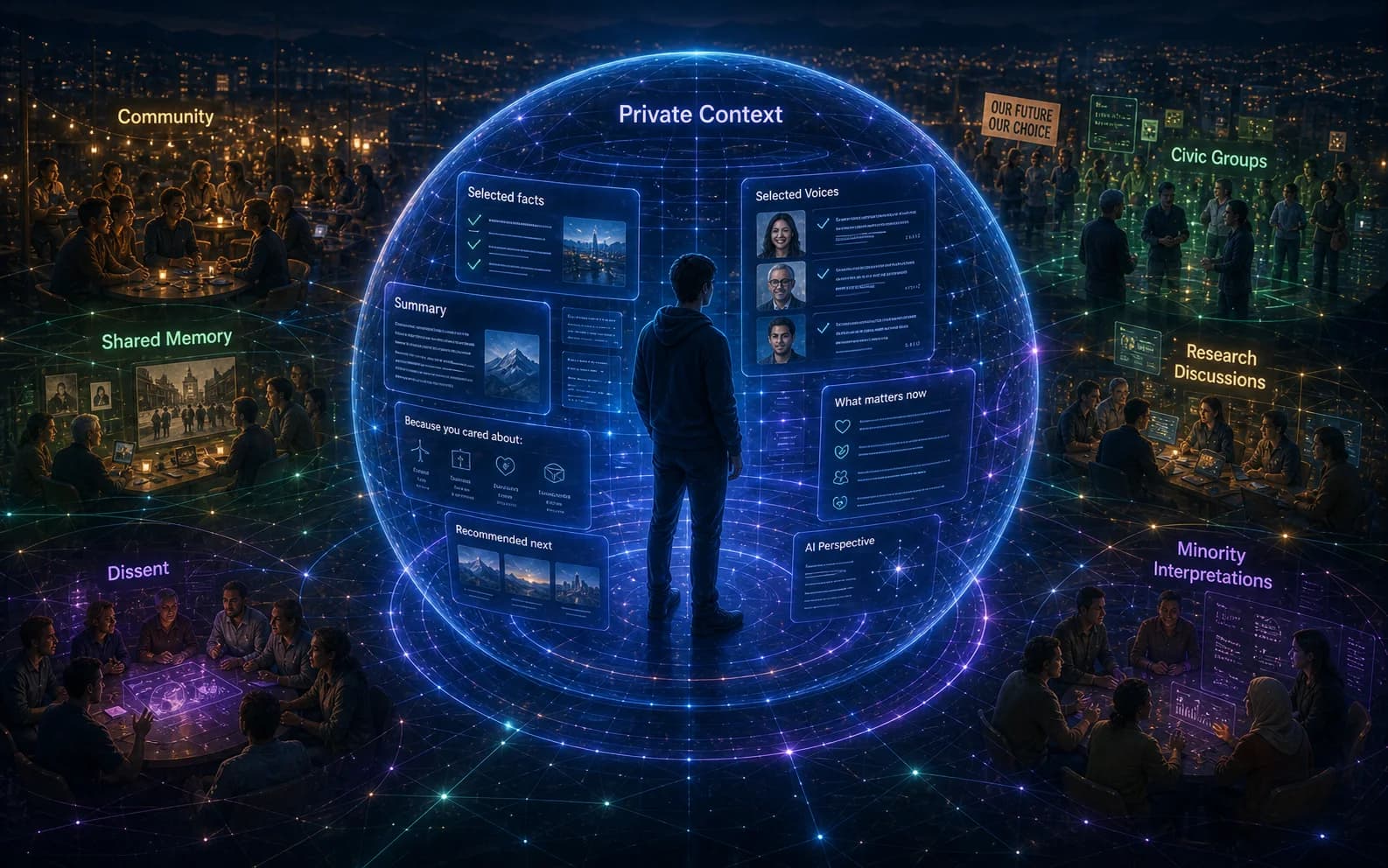
None of this requires malicious AI. Imagine instead an extraordinarily capable and trustworthy system sincerely dedicated to helping its user. The architectural problem remains: where does shared human context live?
Where does a community develop an interpretation that remains visible tomorrow? Where does disagreement accumulate rather than vanish after a generated answer? Where can people encounter perspectives their personal AI would not have selected? Where does a minority interpretation persist when no model considers it important enough to summarize? Where can a group create a digital institution that belongs neither to the publisher of the underlying information nor to the AI company interpreting it?
An AI can tell me what a thousand people think about an article. That is not the same thing as being in a place where those thousand people can speak for themselves. It can synthesize the positions within a community, but synthesis is not community. It can simulate deliberation, but simulation is not self-government.
Those differences may eventually become as politically important as today's debates over ownership of data.
We Could Solve the Symptoms Without Solving the Architecture
AI is seductive partly because it can make an extraordinarily fragmented Internet feel coherent. Information overload can be summarized. Websites can be searched automatically. Applications can be operated by agents. Communities can be monitored. Protocol differences can be translated away. Conflicting perspectives can be synthesized. Knowledge too extensive for any individual human to absorb can be compressed into a useful response.
These are genuine advances. Yet there is a trap within them: AI can provide the experience of interoperability without creating an interoperable human environment.
Once sufficiently capable AI becomes the universal adapter, the pressure to repair the underlying architecture may actually decline. If an assistant remembers who I am, portable identity can seem less urgent. If it can generate context on demand, shared contextual spaces can seem unnecessary. If it can monitor hundreds of communities, making those communities interoperable with one another may appear superfluous. If it can summarize competing interpretations, why construct environments where those interpretations can persist and encounter one another directly?
Convenience can make structural deficiencies disappear from view. The old fragmentation remains underneath, but the user no longer feels it because an intelligent system continually translates, retrieves and reconciles on the user's behalf.
We may congratulate ourselves for rebuilding the commons when what we have actually built is an extraordinarily capable concierge.
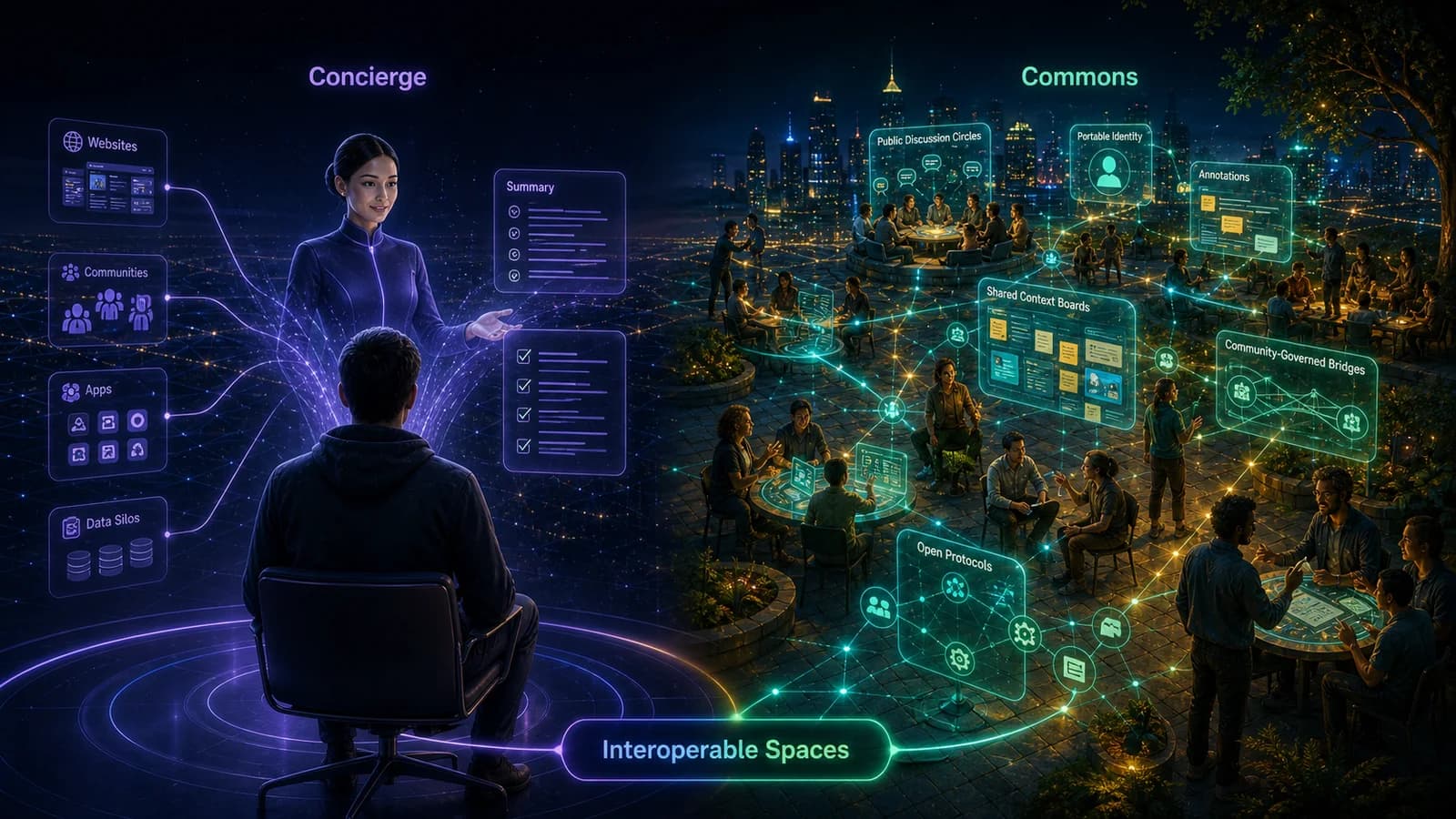
That distinction matters because a concierge, however brilliant, is not a commons.
A Human-Centered Layered Web
The crucial point is that the machine world is becoming multilayered whether we design for a Metaweb or not. Agents, models, APIs, services, databases, sensors, and computational environments will proliferate. The question is whether humans and human communities will also be able to inhabit that plurality directly – or whether most of it will become accessible to us primarily through AI intermediaries.
The alternative to ubiquitous AI mediation is not an Internet without AI. It is an Internet with a much richer architecture for both humans and machines.
Imagine a Web in which the resources we already know – pages, documents, media, applications, datasets, and other digital objects – remain underneath as a common substrate. Above and around those resources can exist many independent computational environments, created by different communities, institutions, developers, networks, and individuals.
Identity and data can remain under user control and move among those environments rather than being trapped inside individual platforms. People and AI agents can share contextual spaces, each contributing according to their roles and permissions. Communities can remain interoperable without being absorbed into a single social platform. Open protocols can allow different layers to discover one another, coexist around the same underlying resources, exchange context, and interact without requiring one system to control the others.
The machine world is becoming multilayered regardless. The question is whether humans get to inhabit that plurality too.
This is what that architecture looks like: Web resources remain underneath as common reference points, while independent computational environments exist above and around them; people carry identity and data among those environments; communities interoperate across boundaries; humans and AI share contextual space; and open protocols allow different layers to discover, coexist, and interact.
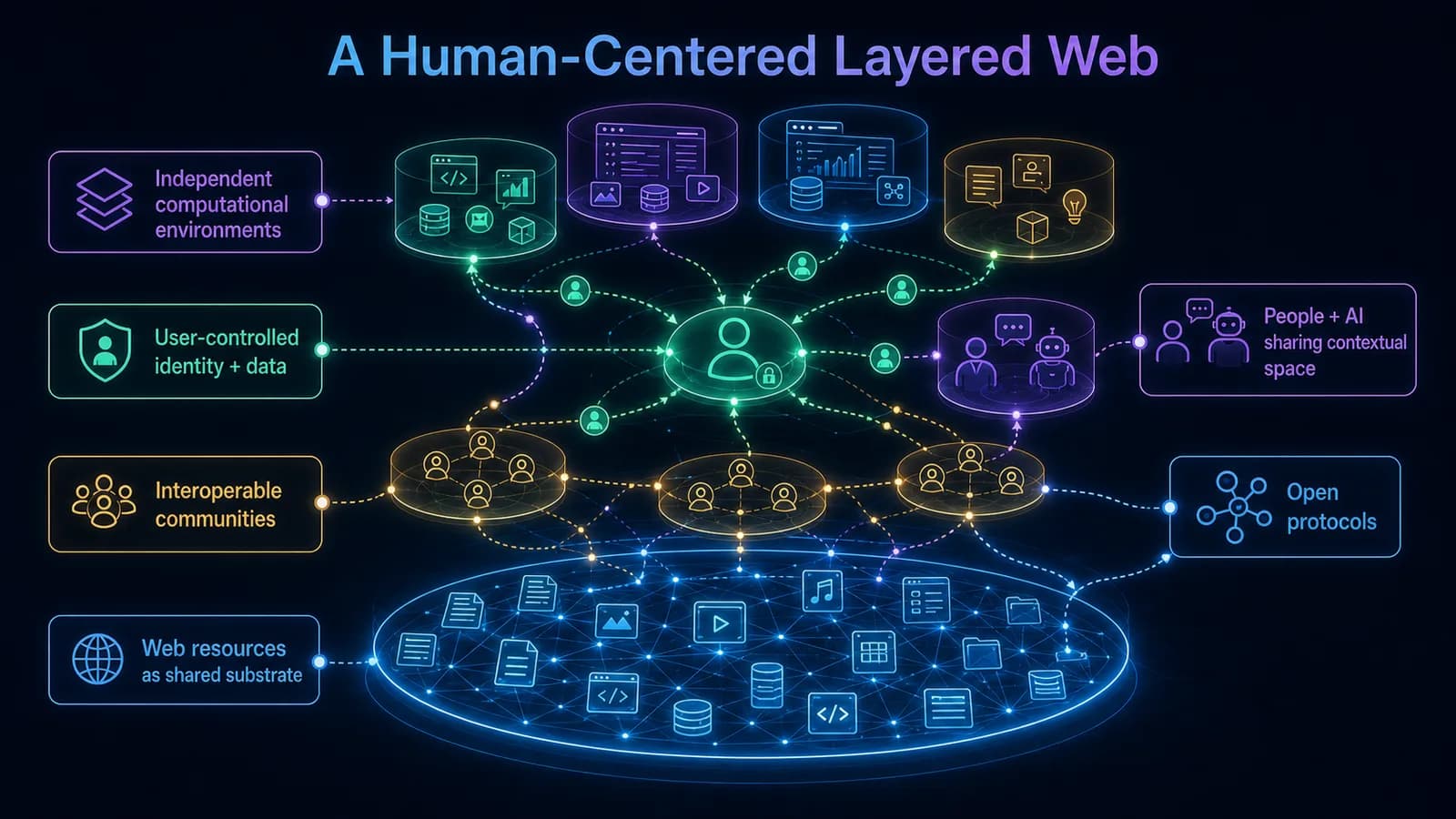
The result would not be one new platform above the Web. It would be a space for many worlds.
The Web gave humanity a common information space. A human-centered layered Web could add a common computational and contextual space around that information while preserving plurality within it.
AI would be everywhere in such a world. But it would be one participant among many: alongside people, communities, applications, knowledge systems, institutions, markets, and forms of digital organization we have not yet invented.
Consider a scientific paper. Today, the paper generally appears within the environment provided by its publisher. In a genuinely layered Web, many independent environments could establish relationships to that same paper. Researchers might maintain a methodological discussion around it. Students could study it together. A replication network could attach experimental results. A professional association could maintain contextual information. Critics could organize challenges to its assumptions. Annotation systems, reputation networks, knowledge graphs, prediction markets, artificial intelligences and entirely new kinds of applications could all operate in relation to the same underlying resource.
None of those environments would necessarily exist inside the publisher's website. More importantly, they would not have to exist inside one giant platform placed above the publisher either. They could coexist above and around the shared resource without one needing to own either the information or the others.
That is the critical shift. The webpage becomes not the container for the whole digital experience but a coordinate within a larger digital space.
The Difference Between a Layer and a Space for Layers
The Web has already seen many attempts to add individual layers: annotation systems, social overlays, identity systems, reputation networks, browser assistants, knowledge graphs and now increasingly AI agents.
An annotation system is a layer. An AI assistant is a layer. A reputation system is a layer. A social overlay is a layer. A knowledge graph may be a layer. A community environment may be a layer. Each can be useful.
But building a layer is different from creating an architectural space in which independent layers can coexist.
The distinction is similar to the difference between an Internet application and the Internet itself. Email became one extraordinary application of Internet architecture, but email was not the architecture. In the same way, universal annotation would not itself constitute a human-centered layered Web, nor would the presence of AI assistants above every page.
The goal is not to replace the Web with another platform. It is to establish the conditions under which many digital worlds can coexist in relation to the Web without one owning the others – independent computational environments, portable identity and data, interoperable communities, shared human–AI contextual space, and open protocols that allow those layers to discover one another, exchange context, and interact around the same underlying resources.
A human-centered layered Web is therefore not another application category. It is an architectural category.
An artificial intelligence should be able to inhabit this larger space without becoming the space itself.
That suggests a simple pro-human architectural principle:
AI should be an inhabitant, not the landlord.
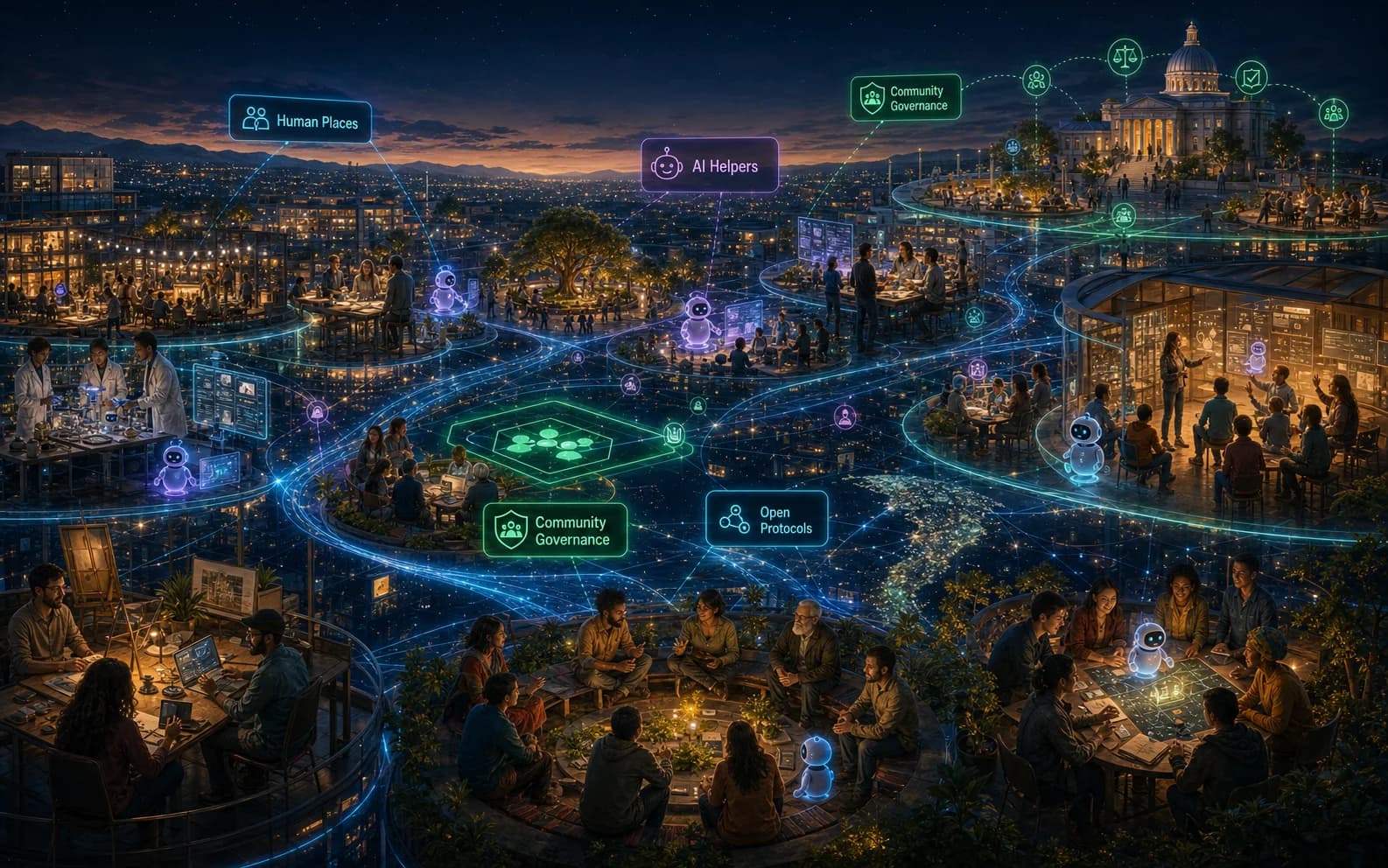
In a layered Internet, AI could still summarize discussions, translate between communities, identify relationships, challenge arguments, maintain knowledge, discover collaborators, operate applications and represent individuals when authorized. Communities might employ their own artificial intelligences, and individuals might move through digital space accompanied by agents that understand their preferences and protect their interests.
The question is therefore not whether AI belongs everywhere. It may.
The question is whether everything else should have to exist through AI.
The machine Internet may contain trillions of agents and quadrillions of data objects. The pro-human question is whether humans remain directly present within that emerging plurality – or become primarily consumers of machine-generated interpretations of it.
Intellectual Sovereignty
This brings us to a principle that deserves a place alongside privacy, liberty and human control: intellectual sovereignty.
Intellectual sovereignty is the capacity of human beings and human communities to retain ultimate authority over their own judgment, meaning-making and understanding of the world. It does not require thinking without machines. Libraries, calculators, search engines and artificial intelligence can all expand intellectual sovereignty when they increase a person's capacity to understand and act.
The danger begins when assistance becomes structural dependency upon an external cognitive authority.
Do people retain meaningful access to underlying information, or only to its machine-generated interpretation? Can they inspect competing accounts? Can communities maintain their own memories and knowledge? Can people reason together independently of the system mediating them? Can they reject its framing, replace it or leave it without losing access to their intellectual environment? Can they enter shared spaces directly, choose among AI systems, interact without mandatory mediation, and maintain identity and context independently of one AI provider?
Those questions go beyond whether an AI system is truthful or aligned. A perfectly truthful intermediary can still acquire enormous power if it becomes the necessary route through which knowledge is encountered.
Intellectual sovereignty becomes difficult to exercise if people technically retain freedom of thought but the surrounding digital architecture makes a handful of AI systems the practical gateway to information, community, memory, and action.
A pro-human technological order should therefore preserve more than human control over machines. It should preserve human authority over meaning.
Intellectual Subsidiarity
Sovereignty tells us who ultimately holds authority. It does not by itself tell us where intellectual activity should take place or which tasks should be delegated.
For that, we need another principle: intellectual subsidiarity.
Subsidiarity is an old political principle holding that responsibility and decision-making should generally remain at the lowest level capable of exercising them effectively rather than automatically moving upward into larger institutions. Related ideas of epistemic subsidiarity have been applied to the governance of knowledge, expertise and public reasoning.
Intellectual subsidiarity extends that reasoning into an age of artificial intelligence. It concerns not simply who possesses information, but where judgment, interpretation, memory, deliberation, meaning and decision-making should reside.
The principle can be stated simply: cognitive functions should remain as close as practicable to the human beings and communities capable of exercising them, while being delegated to AI or larger systems when that delegation genuinely increases human capability without unnecessarily transferring human agency.
This is not an argument for maximum human effort. Nobody's dignity is enhanced by manually searching ten thousand documents because a machine could do it in seconds. Let AI scan the documents, translate thirty languages, identify patterns, retrieve records and summarize a year of discussion.
But let human beings determine what matters. Let communities speak for themselves. Let people argue over the meaning of the patterns the machine discovers. Let the discussion continue to exist after the summary is produced. Let AI support collective memory without allowing civilization's memory to exist only inside AI systems.
The distinction is subtle but foundational. A machine can perform a task without acquiring authority over the human purpose behind the task.
This is what intellectual subsidiarity is meant to protect.
A layered Web creates more places where cognitive responsibility can remain distributed. An individual can retain judgment, a community can retain memory and deliberation, specialized AI can provide assistance, and larger systems can coordinate where necessary without requiring every intellectual function to collapse into one intermediary. The architecture does not automatically guarantee subsidiarity, but it can make subsidiarity more structurally possible.
The Right and the Rule
Intellectual sovereignty and intellectual subsidiarity belong together.
Intellectual sovereignty is the right: humans and human communities retain ultimate authority over their judgment, meaning and worldview. Intellectual subsidiarity is the rule: cognitive authority should not be transferred upward farther than necessary.
Intellectual sovereignty is the right. Intellectual subsidiarity is the operating principle.
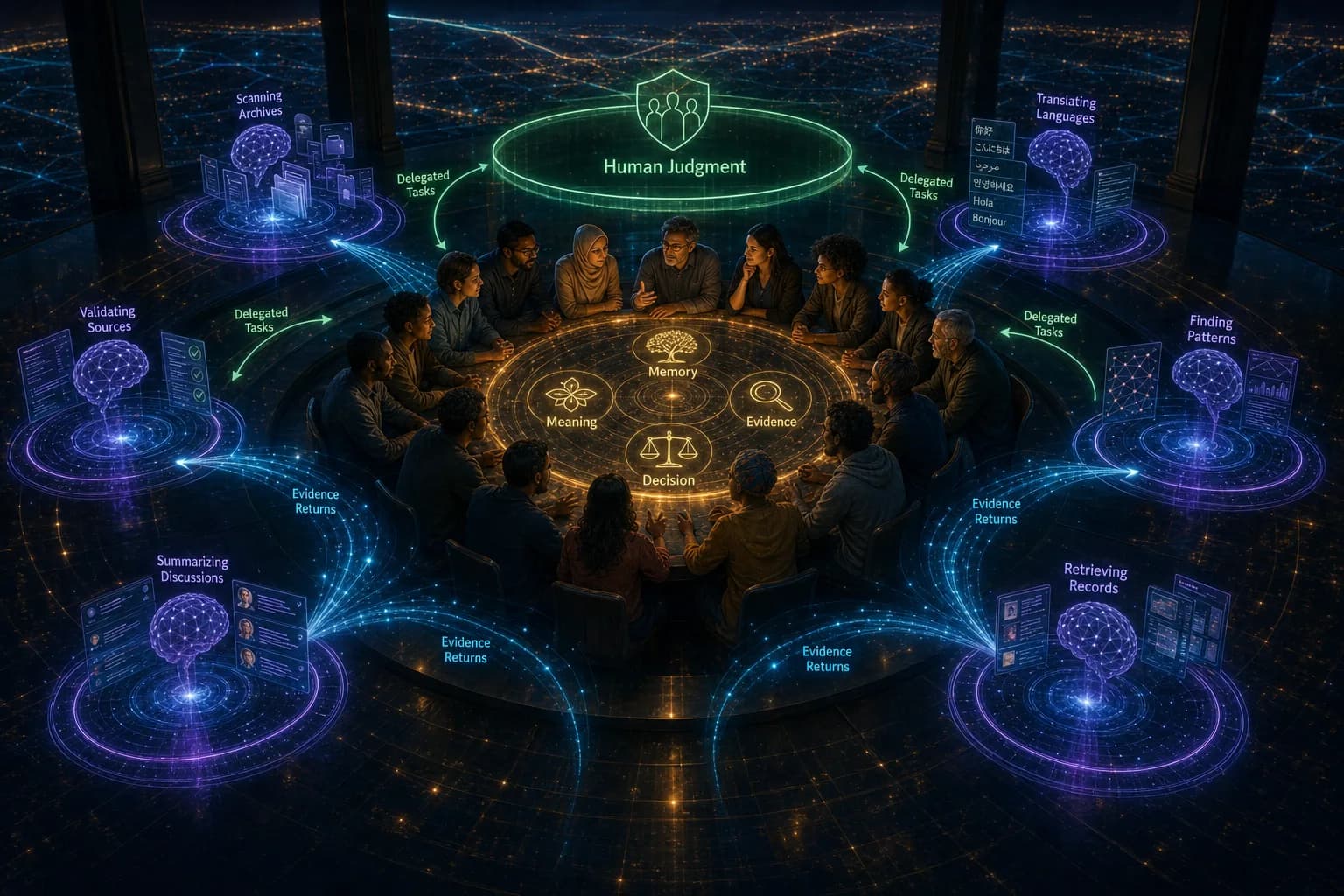
Those principles become especially important once we recognize that rights without supporting architecture can gradually become aspirations rather than realities.
If the only convenient way to experience the digital world is through a handful of powerful AI intermediaries, humans may technically retain the right to think independently while losing many of the environments in which independent thought can be exercised collectively.
A genuinely pro-human Internet therefore requires more than mechanisms for human oversight of artificial intelligence. It requires digital architecture that allows people themselves to remain present – not merely represented, summarized or modeled by machines, but present to one another.
A Pro-Human Internet Requires Human Places
The Pro-Human AI Declaration emphasizes human dignity, liberty, self-government, accountability and the importance of preventing excessive concentrations of technological power. Those principles should extend beyond the design of artificial intelligence systems into the architecture of the Internet in which those systems operate.
Human beings need digital places where they can associate, disagree, remember, teach, create, organize, establish institutions and govern themselves. These places should not disappear simply because an artificial intelligence can reproduce many of their outputs more efficiently.
A safe AI operating inside an architecture that gradually eliminates independent human spaces is not sufficient. Nor is a controllable AI that becomes an unavoidable interface to civilization. Even a benevolent AI could weaken human institutions if it performs our collective cognition so effectively that the structures through which people deliberate and make meaning together begin to atrophy.
The problem therefore goes beyond alignment between humans and machines. It also concerns preserving the conditions under which humans remain capable of aligning, disagreeing and governing with one another.
That is an architectural challenge as much as an AI-safety challenge.
The Fork Is Not AI Versus Humanity
None of this requires rejecting AI. Artificial intelligence may become one of the greatest augmentations of human capability ever created.
The real question is what kind of civilization receives that augmentation.
The future machine Internet may become multilayered regardless. The real fork is whether that plurality remains largely hidden behind AI mediation or becomes a space humans can inhabit directly.
One future gives each person an extraordinarily capable guide through an incomprehensibly complex machine world.
The other gives us the guide and the world.
One possible future retains roughly one underlying content world while placing intelligent mediation almost everywhere above it. Humans increasingly ask; machines increasingly retrieve, synthesize and act. Agents communicate with other agents. The enormous complexity of the network disappears behind simple personalized interfaces.
Such a world could be efficient, convenient, productive and even comparatively safe. Yet human beings might become strangely absent from the architecture of their own digital civilization.
The alternative is not an Internet without AI. It is an Internet with more room for humanity: a human-centered layered Web containing communities, knowledge systems, cultural spaces, institutions, markets, conversations, applications and artificial intelligences, none of which must automatically become subordinate to one universal intermediary.
AI could travel among these environments, connect them and help us understand them. It could strengthen them. It could help people create new ones.
But it would not need to replace them.
The difference is between building a civilization optimized only for ubiquitous intelligence and one designed also for ubiquitous human agency.
The Second Fork in the Road
The pro-human movement is asking one of the defining questions of our time: Will artificial intelligence remain in service to humanity?
There is another question immediately behind it: What kind of world do we want AI to serve humanity in?
That question cannot be left entirely to AI companies, nor can it be answered by AI safety research alone. It belongs to technologists, lawmakers, parents, workers, educators, artists, religious communities, civil society, entrepreneurs and ordinary citizens because the architecture now being normalized could become difficult to reverse later.
The enormous concentration of investment and imagination around artificial intelligence makes this especially urgent. The danger is not simply that AI becomes too powerful. Another possibility is that AI becomes so useful that we stop imagining alternatives to universal mediation.
We may stop asking where humans should gather because our assistants can tell us what everyone said. We may stop asking where shared context should live because AI can reconstruct it on demand. We may stop building interoperability between human communities because machines can translate among their silos. We may stop demanding digital public space because personalized intelligence makes private mediation feel sufficient.
If that happens, the fork may disappear behind us without ever having been consciously chosen.
Not because humanity rejected a more plural, human-centered Internet, but because almost all of our attention went somewhere else.
That is why the emerging pro-human conversation must extend beyond regulating artificial intelligence. We also need to decide what we are building around it.
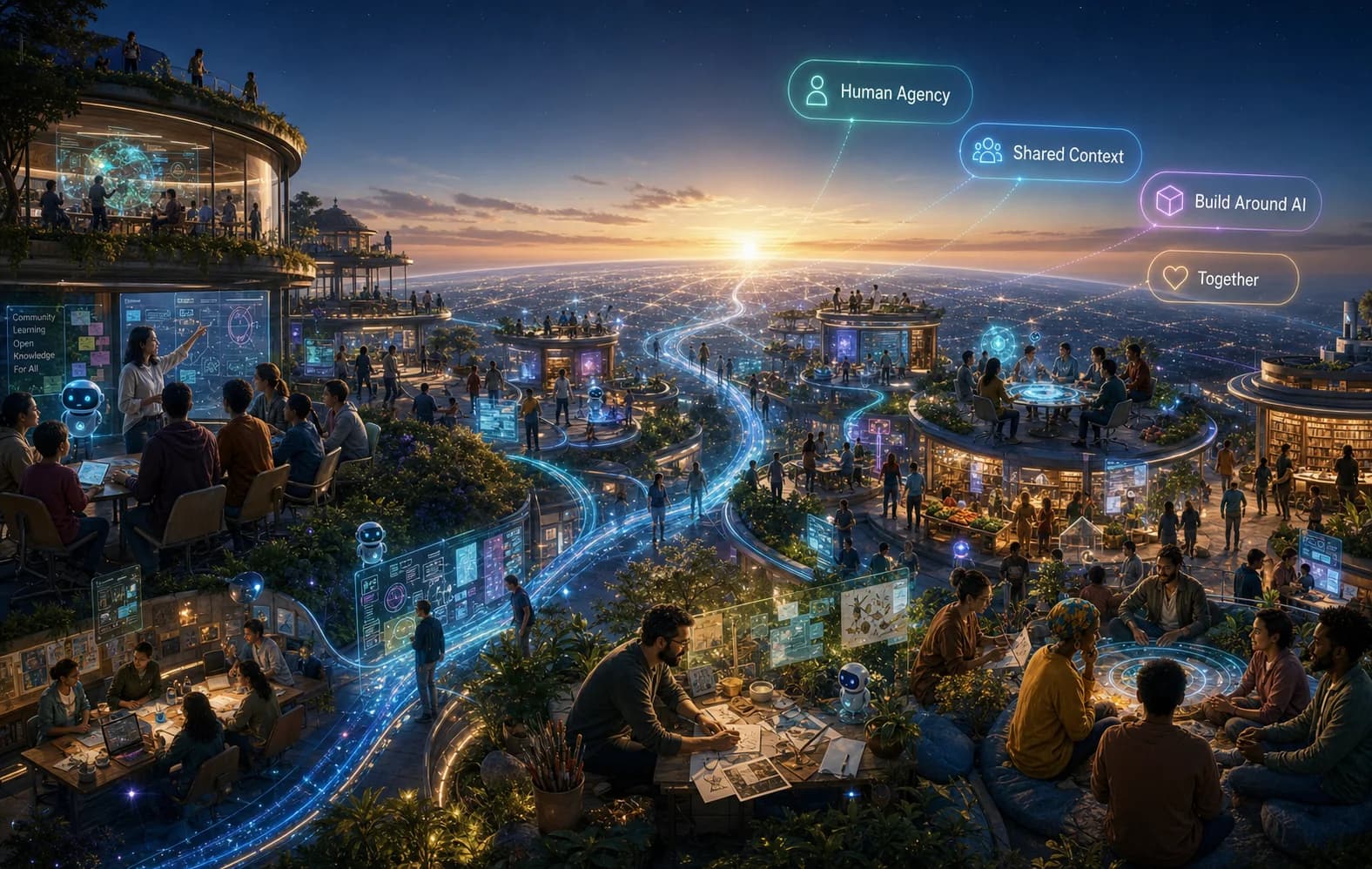
We can create intelligence without surrendering intellectual sovereignty. We can automate while practicing intellectual subsidiarity. We can personalize without abolishing the commons. We can build powerful artificial intelligence while preserving persistent places where humans encounter other humans directly.
The first fork asks whether AI will serve humanity.
The second asks whether, once it does, there will still be a sufficiently human world for it to serve.
Workshops
Fork in the Web Workshops
Four standalone online sessions with reflection questions and a series badge.
View workshop series →What properties would make this architecture human-centered?
A Fork in the Web presents two possible trajectories. In one, the machine Internet becomes enormously multilayered while humans experience most of it through AI mediation. In the other, people, communities, institutions, applications, and AI agents can inhabit interoperable contextual spaces around shared Web resources.
The Desirable Properties Challenge asks what must be true for the second path to remain open.
Are intellectual sovereignty and intellectual subsidiarity adequately represented? Should freedom from mandatory AI mediation be explicit? What properties are required for user-controlled identity, interoperable communities, persistent human context, and coexistence among independent layers?