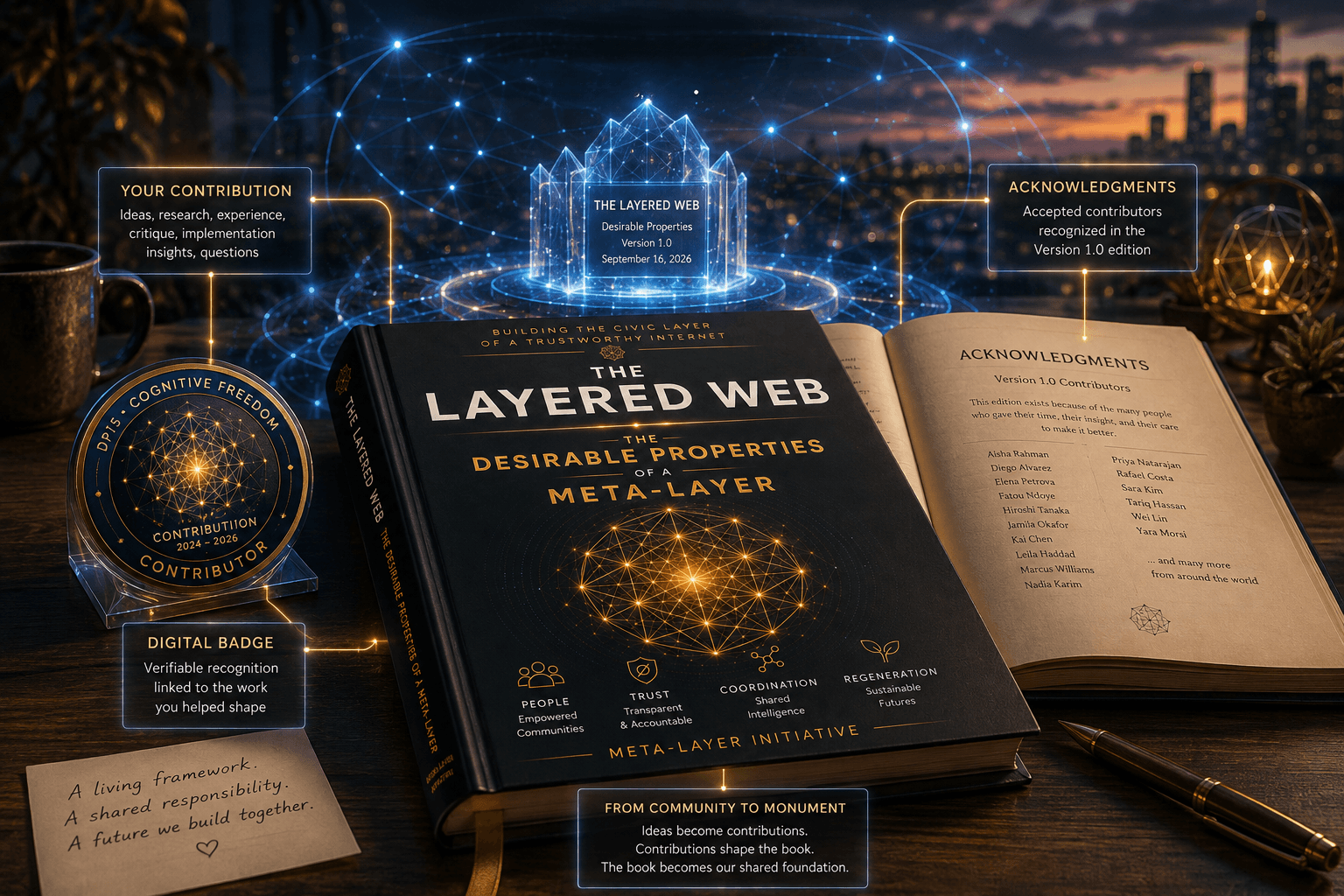
Weigh in on the Desirable Properties
If you represent Dcc, confirm the source URLs, then open the Desirable Properties tab and leave a patch idea where the property text misses what your public work already argues.
These directions are generated from Dcc's public corpus, not from private landing pads. Each one is a hypothesis. Follow the interest that feels like your work. The Deepi prompt and Discuss link are real contribution paths, not a brochure.
DP8 · hypothesis
Collaborative Environment and Meta-Communities
Your stated mission ("Building the digital credential infrastructure for the future A White Paper by the Digital Credentials Consortium -- 1 of 38 -- This work is licensed under a Creative Commons Attribution-ShareAlike 4.0 International License 1 Editors : • Kim Hamilton Duffy (Chair, W3C Credentials Community Group) • Hans Pongratz • J.") sits next to DP8's human issue: Online communities constantly restart. Guiding question: How do communities persist beyond platforms?
Direction to explore
How do Alliance members share a collaboration space without collapsing into one platform community?
Candidate patch idea
Define meta-communities as optional shared rooms with explicit consent, not an ambient social network that harvests the Alliance listserv.
DP20 · hypothesis
Community Ownership
Your stated mission ("Building the digital credential infrastructure for the future A White Paper by the Digital Credentials Consortium -- 1 of 38 -- This work is licensed under a Creative Commons Attribution-ShareAlike 4.0 International License 1 Editors : • Kim Hamilton Duffy (Chair, W3C Credentials Community Group) • Hans Pongratz • J.") sits next to DP20's human issue: Platforms own everything users create. Guiding question: Who should own the next layer of the Internet?
Direction to explore
This is the anti-capture test: can Dcc's coordination space stay owned by people if commercial players arrive later?
Candidate patch idea
Strengthen anti-capture language: community rules and exit rights are written before large commercial platforms are invited to play.
DP1 · hypothesis
Federated Authentication & Accountability
Your stated mission ("Building the digital credential infrastructure for the future A White Paper by the Digital Credentials Consortium -- 1 of 38 -- This work is licensed under a Creative Commons Attribution-ShareAlike 4.0 International License 1 Editors : • Kim Hamilton Duffy (Chair, W3C Credentials Community Group) • Hans Pongratz • J.") sits next to DP1's human issue: Fake accounts, scams, and impersonation. Guiding question: How can we know who we are interacting with without sacrificing privacy or decentralization?
Direction to explore
Can Dcc's identity work sit beside federated authentication without becoming another platform login?
Candidate patch idea
Clarify in DP1 that self-sovereign or DSNP-class identifiers are valid accountability anchors, not second-class to platform accounts.
DP2 · hypothesis
Participant Agency and Empowerment
Your stated mission ("Building the digital credential infrastructure for the future A White Paper by the Digital Credentials Consortium -- 1 of 38 -- This work is licensed under a Creative Commons Attribution-ShareAlike 4.0 International License 1 Editors : • Kim Hamilton Duffy (Chair, W3C Credentials Community Group) • Hans Pongratz • J.") sits next to DP2's human issue: Algorithms controlling what you see. Guiding question: How do we ensure people stay in control of their digital lives?
Direction to explore
Does Dcc's agency claim stop at data export, or does it include control of attention and presence?
Candidate patch idea
Add that portable social graphs and presence settings are required expressions of participant agency, not optional app features.
DP5 · hypothesis
Decentralized Namespace
Your stated mission ("Building the digital credential infrastructure for the future A White Paper by the Digital Credentials Consortium -- 1 of 38 -- This work is licensed under a Creative Commons Attribution-ShareAlike 4.0 International License 1 Editors : • Kim Hamilton Duffy (Chair, W3C Credentials Community Group) • Hans Pongratz • J.") sits next to DP5's human issue: Losing your identity when platforms change. Guiding question: How do names and identities persist when platforms change?
Direction to explore
Should Frequency / namespace work be named as an example of decentralized naming rather than a single mandated stack?
Candidate patch idea
Note that multiple naming systems may coexist if they remain user-portable and are not captured by one commercial resolver.
DP10 · hypothesis
Education
Your stated mission ("Building the digital credential infrastructure for the future A White Paper by the Digital Credentials Consortium -- 1 of 38 -- This work is licensed under a Creative Commons Attribution-ShareAlike 4.0 International License 1 Editors : • Kim Hamilton Duffy (Chair, W3C Credentials Community Group) • Hans Pongratz • J.") sits next to DP10's human issue: Information overload. Guiding question: How do we learn continuously without drowning in fragmented information?
Direction to explore
What should researchers and fellows be invited to teach or contest in the DP corpus?
Candidate patch idea
Add that educational onboarding must show the live patch trail, not only a finished property statement.