
Meta-Layer Initiative · Start here
Help define a trustworthy layer above the Web
Desirable Properties are public design criteria for the Meta-Layer: what must stay true across implementations. The Community Review Draft is published. The next milestone is Version 1.0 on November 13, 2026.
Current draft: Version 0.77. The workgroup Collaborate page is where groups take a DP to Version 1.0. Commenting on the book is the lighter path.
Two ways to contribute
You do not need to do both. If you will stay with a property through November, the Collaborate page is the workgroup home.
Primary for Version 1.0 · Collaborate page
Join a workgroup Collaborate page
Each DP has a Collaborate page. That is the workgroup workspace, not a side tab. Use Astra to review editorial synthesis, Edit to propose chapter changes, and Canopi to post, comment, review, and like. We want at least 3 people per workgroup. If a group is smaller, invite others.
Sign in when you open Collaborate. Joining the workgroup, Astra, Edit, and Canopi (post, comment, review, like) need a session. Use Sign In in the header, then return to the Collaborate page.
Also useful · Review and revise
Comment on the book
Prefer 30–90 minutes on a chapter without joining a group? Discuss and suggest wording on book.desirableproperties.org. Passage-level patches can also go to Gov Hub.
Or start from a property
Open the Collaborate page for that DP (workgroup workspace). Comment on the chapter if you only want to review.
- DP1 Federated Authentication & Accountability
- DP2 Participant Agency and Empowerment
- DP3 Adaptive Governance Supporting an Exponentially Growing Community
- DP4 Data Sovereignty and Privacy
- DP5 Decentralized Namespace
- DP6 Commerce
- DP7 Simplicity and Interoperability
- DP8 Collaborative Environment and Meta-Communities
- DP9 Developer and Community Incentives
- DP10 Education
- DP11 Safe and Ethical AI
- DP12 Community-based AI Governance
- DP13 AI Containment
- DP14 Trust and Transparency
- DP15 Security and Provenance
- DP16 Roadmap and Milestones
- DP17 Financial Sustainability
- DP18 Feedback Loops and Reputation
- DP19 Amplifying Presence and Community Engagement
- DP20 Community Ownership
- DP21 Multi-modal
- DP22 Civic Memory & Epistemic Continuity
- DP23 Universal Participation & Linguistic Interoperability
The page is not the whole room
Today's Web often feels like a flat surface of pages, feeds, apps, and platforms. The Metaweb asks us to see the Web as a multi-layered environment where people, knowledge, interactions, and governance can have presence above the webpage.
The Meta-Layer is a community-governed coordination layer above today's Web: a shared digital atmosphere for context, trust, memory, and collective intelligence without replacing the content you already use.
- Context
- Presence
- Trust
- Governance
Read the full framing on About or in the opening chapter of The Layered Web: The Desirable Properties of a Meta-Layer.
From vision to initiative
The Metaweb: The Next Level of the Internet introduced the layered Web as a safe, AI-aware environment for privacy, accountability, collaboration, and collective intelligence. That vision catalyzed a public build process: if there is to be a layer above the Web, how should it be designed, governed, and evaluated?
- Step 1
Book
A new way to see the Web
Learn more → - Step 2
Kickoff
A shared design question
Learn more → - Step 3
DPs
Public design criteria
Learn more → - Step 4
Requirements
Testable obligations
Learn more → - Step 5
Substrate
Shared infrastructure
Learn more →
The September 2024 kickoff with Vint Cerf named an essay on desirable properties as the first milestone. See the kickoff summary and the full challenge timeline.
What should be true of a trustworthy layer above the Web?
Before requirements, technical specs, or architecture decisions, the community needs shared criteria. What makes this layer desirable? What harms must it avoid? What capacities must it enable?
That question launches the Desirable Properties Challenge: refine, debate, test, and improve living drafts on the path toward Version 1.0 and substrate work.
What is a Desirable Property?
A Desirable Property (DP) is a public design criterion for the layer above the Web. It describes a condition the Meta-Layer should satisfy: whatever we build, this property should be visible, reviewable, and operationalizable.
A DP is not one implementation. The same property can be tested across:
- An overlay app
- Browser integration
- An SDK or library
- A community tool
DPs describe outcomes and conditions (the “what” humanity wants). They are not RFCs or product requirements. Multiple implementations can coexist while staying aligned on shared outcomes. See FAQ: Start here.
From property to shared infrastructure
Desirable Properties guide requirements. Requirements shape architecture decisions. Architecture decisions shape the Overweb substrate. The substrate then supports overlay apps, smart tags, presence, filters, meta-communities, and governance.
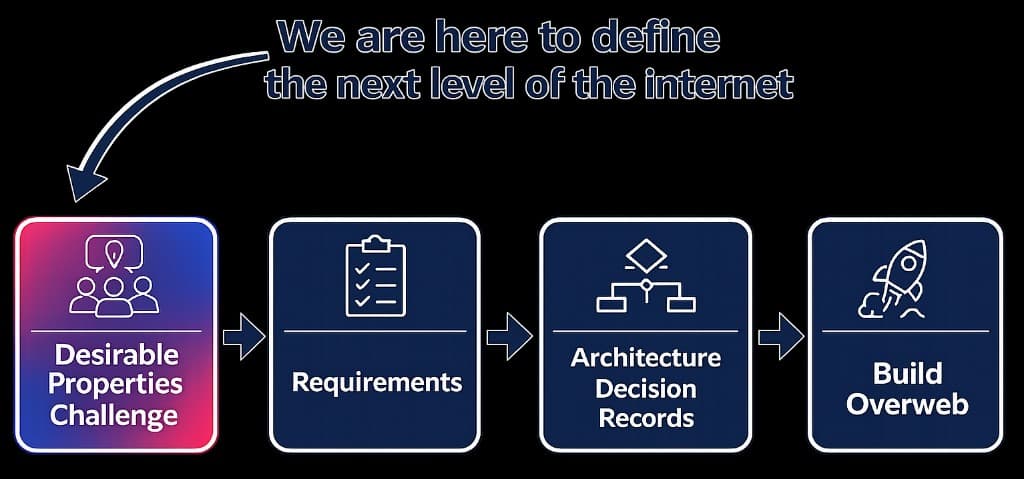
DP
What must be true?
Community-defined criteria that any implementation should satisfy.
ML-REQ
What must systems satisfy?
Testable requirements derived from accepted properties.
ML-ADR
What do we choose, and why?
Documented architecture decisions with explicit rationale.
Overweb
What shared layer makes it usable?
Substrate for overlays, smart tags, presence, filters, and governance.
Six families of Desirable Properties
The Community Review Draft organizes 23 canonical DPs into six families. You do not need to read every property. Pick one that matches your lens.
Authentication and Accountability
DP1 · DP2 · DP3
Sovereignty and Privacy
DP4 · DP5 · DP6
Interoperability and Participant Experience
DP7 · DP8 · DP9 · DP10 · DP21 · DP23
AI Governance and Safety
DP11 · DP12 · DP13
Security, Transparency, & Trust
DP14 · DP15 · DP16 · DP17 · DP22
Community Participation and Feedback
DP18 · DP19 · DP20
From community review to Version 1.0
Public review is open. Workgroup synthesis now aims at Version 1.0, then candidate requirements, architecture decisions, and implementation evidence.
September 16, 2026 · past
Community Review Draft milestone. What shipped
Now through November 13, 2026
Book discussion, workgroup Astra and Edit work, Canopi conversation, and recruitment to at least 3 people per workgroup
November 13, 2026 · target
Version 1.0 release target (Desirable Properties Version 1.0 release). Dates are targets, not guaranteed ship dates.
The Overweb will be built in public
Choose one DP. Bring one improvement.
Comment on a chapter, or join a workgroup and help take it to Version 1.0 by November 13, 2026.